Owe $10,000+ on cards or medical bills? See who qualifies for a nationally available debt relief program, what it costs and how to apply.
Below: who qualifies, what it really costs and how to apply without falling for a scam.
📄 In this article
What a nationally available debt relief program is and who qualifies
A nationally available debt relief program is a private debt settlement service, offered across most of the country, that negotiates your unsecured debts so you pay back less than the full balance, without taking out a new loan. It is not a government program: National Debt Relief, the best known company behind the phrase, confirms in its own FAQ that it is a private company.
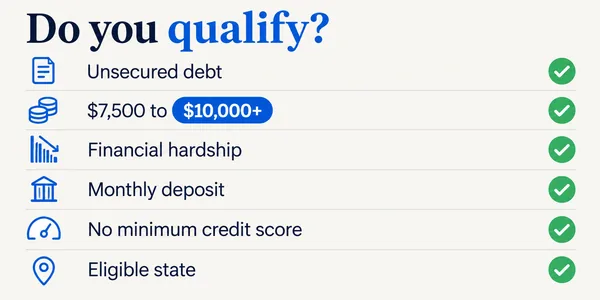
You qualify when you meet all six requirements below.
| ✅ Requirement | What it means in practice |
|---|---|
| 💳 Type of debt | Unsecured: credit cards, store cards, medical bills, personal loans, lines of credit, collections, some private student loans |
| 💰 Minimum amount | $7,500 to $10,000 in unsecured debt (National Debt Relief lists both figures on different pages) |
| 📈 Hardship | Job loss, medical emergency, divorce, death of a spouse or a drop in income |
| 📅 Monthly deposit | You can save a fixed amount every month to fund the settlements |
| 📊 Credit score | No minimum score required |
| 🗺️ State | Not offered in Connecticut, Oregon, Vermont, West Virginia or Wisconsin |
These criteria come from the National Debt Relief qualification guide and from NerdWallet’s review of the company. Mortgages, car loans, past due taxes and federal student loans are not eligible. The company also gives a useful rule of thumb: settlement deserves a look when your unsecured debt reaches about half of your gross yearly household income. Someone earning $60,000 with $30,000 in card and medical debt is right in that zone.
If you checked most of those boxes, the fastest next step is a free eligibility check, and the rest of this guide shows you exactly what happens after it.
Free consultation · No upfront fees · No new loan
Why another loan or bankruptcy can cost you more than a debt relief program
For most people who are already behind on payments, a new loan only moves the debt and bankruptcy leaves the longest mark, while a settlement program attacks the balance itself. Three cards close to the limit, a hospital bill already in collections, a personal loan from the last emergency. You pay the minimums and the total barely moves, because most of each payment goes to interest.
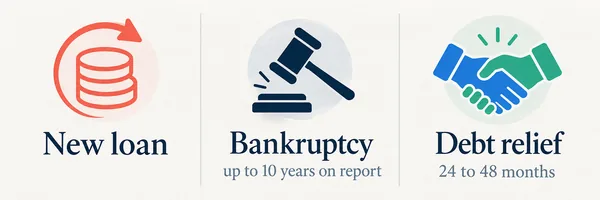
| Criteria | 💳 New loan | ⚖️ Bankruptcy | 🤝 Debt relief |
|---|---|---|---|
| New borrowing | ✗ Yes | ✓ No | ✓ No |
| Court case | ✓ No | ✗ Yes | ✓ No |
| Typical length | Several years of payments | 3 to 6 months (Ch. 7) or 3 to 5 years (Ch. 13) | 24 to 48 months |
| Credit report mark | New account and hard inquiry | Up to 10 years | Up to 7 years |
| Cost | Interest, rate may rise after a teaser period | Filing fee plus attorney fees, often thousands | Up to 25% of enrolled debt, after settlement |
| Balance reduced | ✗ No | Discharged or repaid by plan | ✓ Settled for less |
Sources: CFPB, Debt.org, National Debt Relief and NerdWallet. Results vary by person and creditor.
💳
Option one is a consolidation loan.
The CFPB warns that some of these loans start with a low teaser rate that rises later, and a longer term can make the total cost higher than the original debt. Your cards are also open again the next morning, and one car repair later you owe the loan and the cards.
⚖️
Option two is bankruptcy.
Debt.org notes that a Chapter 7 filing can stay on your credit report for up to 10 years, a Chapter 13 plan lasts three to five years, and attorney fees often reach thousands of dollars on top of the court filing fee.
🤝
Option three is the one most ads skip.
One monthly deposit into an account you own. Negotiators settling one creditor at a time, with every offer approved by you first. No new loan and no court case. Typical programs finish in 24 to 48 months, according to National Debt Relief.
That is the bridge a debt relief program offers. It is not painless, though, and the price deserves a hard look before you decide.
What a debt relief program really costs and what it does to your credit
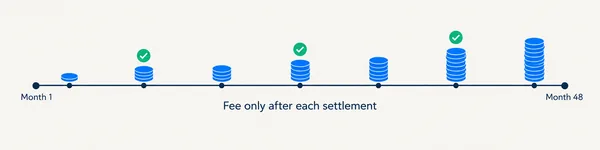
You pay nothing upfront: federal rules ban debt relief companies from charging fees before they settle a debt, and National Debt Relief charges up to 25% of the enrolled debt only after a settlement is reached, approved by you and paid at least once. Here is the full picture, in numbers.
📊 The numbers, according to the company
- 💵 Fees: 15% to 25% of the enrolled debt depending on your state, plus a $9 setup fee and a $9.85 monthly account fee, according to NerdWallet.
- 📈 Savings: about 45% of enrolled debt before fees, or about 20% after fees, according to the company. Results vary and are not guaranteed.
- ⏱️ Timeline: 24 to 48 months for most clients; some plans run longer.
- 📉 Credit score: it drops while enrolled accounts go unpaid, and delinquencies can stay on your report for up to seven years.
- 🏛️ Creditors: the CFPB warns that many lenders do not negotiate with settlement companies, and a creditor can still sue.
- 🧾 Taxes: the IRS treats canceled debt as income, and creditors may send Form 1099-C unless you qualify for an exclusion such as insolvency.
🧮 Do the math on your balance
Put those numbers on your own balance. On $20,000 of enrolled card debt, a 20% net saving after fees would mean about $4,000 less than you owe today. Compare that with interest on a new loan or a bankruptcy on your report for a decade.
Knowing the real price, here is the exact path to apply safely.
How to apply for a debt relief program, step by step
Before you start, gather the latest statement for every unsecured debt, your monthly take home pay and a rough list of your fixed expenses. With that in hand, the process takes one call or one online form.
-
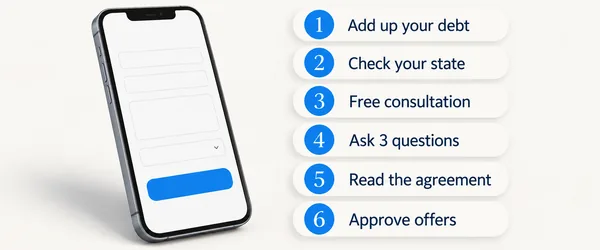
1Add up your unsecured debt
List every card, medical bill, personal loan and collection account. If the total is $10,000 or more, keep going.
-
2Confirm your state
The National Debt Relief program is not available in Connecticut, Oregon, Vermont, West Virginia or Wisconsin. If you live there, call a nonprofit credit counselor instead.
-
3Request the free consultation
Use the official application page or call the number listed on the company’s website (800-300-9550). You should never pay to find out if you qualify.
-
4Ask three questions in writing
What fee percentage applies in my state? How much is my monthly deposit? How many months is my estimated plan?
-
5Read the agreement before signing
Confirm that no fee is charged before a settlement and that your deposits stay in a dedicated account in your name.
-
6Approve each offer and keep records
Save every settlement letter, every court notice and any Form 1099-C for tax season.
🚨 Scam warning signs: The most common mistakes are paying anyone upfront, trusting a guaranteed percentage, believing in a “new government program” and ignoring the tax bill on forgiven debt. The FTC and CFPB list every one of these as warning signs of a scam.
💡 Debt relief
“One monthly deposit, one creditor at a time, and no new loan hanging over your head.”
That is the whole idea behind a debt settlement program.
Debt relief program FAQ
+ Is the national debt relief program a government program?
No. National Debt Relief is a private debt settlement company, and the word national is part of its name, not a sign of federal backing. The FTC warns that companies claiming government ties for debt relief are a classic scam signal.
+ How much debt do I need to qualify for debt relief?
National Debt Relief lists a minimum of $7,500 in unsecured debt on its qualification guide and $10,000 on its settlement page. Owing $10,000 or more in cards, medical bills or personal loans puts you inside both figures.
+ Can I get debt relief without bankruptcy or a new loan?
Yes. Debt settlement replaces both: you make a monthly deposit and negotiators settle each unsecured debt for less than the balance. It still affects your credit, but there is no court case and no new borrowing.
+ Does a debt relief program hurt your credit score?
Yes, at first. Enrolled accounts are reported as late while you save, and those marks can stay for up to seven years. As accounts are settled, your total debt falls, which is what gives you room to rebuild.
+ Is forgiven debt taxable after a settlement?
It can be. The IRS counts canceled debt as income and creditors may send Form 1099-C. If your debts were larger than your assets when the debt was settled, the insolvency exclusion may apply. A tax professional can confirm it.
+ Can creditors sue me while I am in a debt relief program?
They can. National Debt Relief calls it a slight possibility and the CFPB lists lawsuits among the main risks. Keep every letter, never ignore a court notice and tell your program right away if one arrives.
Check your debt relief program eligibility before you sign anything else
You came here at a breaking point: another loan on the table, maybe a bankruptcy form open in another tab. The only number still missing is yours. The eligibility check is free, carries no upfront fee and does not commit you to anything, so run it before you sign for new credit or file any paperwork.

Free to check · No obligation to enroll
⚠️ Editorial notice: This content is informational and independent. HS.C Online is not affiliated with National Debt Relief, any creditor or any government agency, and does not provide legal, tax or financial advice. Fees, minimums and availability can change at any time; confirm the current terms on the company’s official website before you enroll.