Free iPhone government assistance is real!
Read on to see who qualifies, what to send, and how to use the iPhone you already own.
What free iPhone government assistance actually covers
Free iPhone government assistance means the federal Lifeline program takes up to $9.25 off your phone, internet or bundled bill every month, and up to $34.25 for households on qualifying Tribal lands. The money follows the service, never the handset.
| What the benefit does | What it does not do |
|---|---|
| Cuts up to $9.25 a month | Promise any specific phone model |
| Pays up to $34.25 on Tribal lands | Ship devices from a federal office |
| Works for phone or home internet | Cover more than one line per household |
| Stays while you still qualify | Charge you a fee to apply |
Lifeline is run by the Universal Service Administrative Company, known as USAC, with oversight from the Federal Communications Commission. Some providers do hand out a free device to win a new Lifeline customer, and that is where the iPhone rumor started.
Landline, mobile or internet: where the discount can go
The same benefit works on a home landline, a wireless plan or a broadband connection, and on a bundle that mixes voice and data. You choose one of them, because the discount cannot be split across two services or two companies at the same time.
That flexibility is why the searches for government home phone service and free phone service point at the same place. Older relatives who want a landline and a teenager who needs data are using one program with two different outcomes.
So the question is not where the free iPhones are. It is whether your household is already on the list the program checks.
Who qualifies for the Lifeline discount
You qualify in two ways: through a federal assistance program you already receive, or through household income at or below 135% of the Federal Poverty Guidelines.
A child or dependent on any of those programs counts for the whole household, which is what families with seniors on Medicaid usually miss. On qualifying Tribal lands the list grows: Bureau of Indian Affairs General Assistance, Tribal TANF, the Food Distribution Program on Indian Reservations, and income qualified Head Start.
The rule that trips people up is the household one. Only one Lifeline benefit is allowed per household, so two adults sharing an address and a budget cannot each hold a line.
What changes in your month when the bill drops
Nine dollars sounds small until you put it next to the week the balance runs out.
Before the discount, the phone is the first bill people let slide. Service gets suspended, the number dies, and the number was on the job application, the clinic form and the school record. Getting it back costs more than keeping it ever did.
After the discount, the same plan sits inside the budget instead of fighting it. On Tribal lands, where the benefit reaches $34.25 a month, it can cover most of a basic plan. The change is not luxury, it is a line that answers when someone calls you back.
⚠️ Attention: applying for Lifeline costs nothing. Anyone asking for a payment, a gift card or a fee to unlock your free phone is running a scam.
How to apply for Lifeline step by step
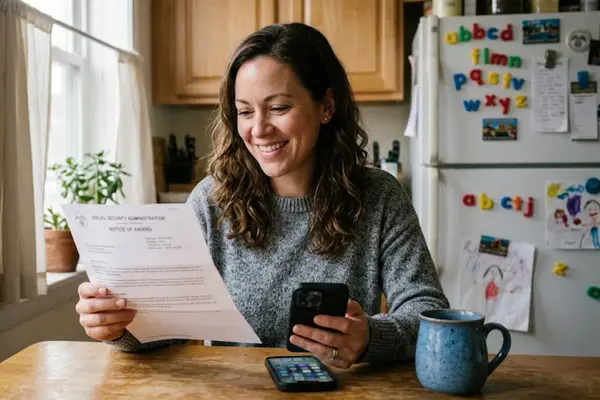
Before you start, gather proof: a benefit award letter, or a tax return or three consecutive pay stubs if you apply by income.
- 1Check eligibility through the National Verifier, the federal system that confirms who qualifies for Lifeline.
- 2Upload your proof only if the databases do not confirm your program or income automatically.
- 3Pick a participating provider that actually has coverage where you sleep, not only where you work.
- 4Apply the benefit to one line, either a new plan or the service you already pay for.
- 5Recertify once a year when USAC or your state asks, or the discount stops without warning.
Two details save weeks. Residents of Oregon and Texas apply through their state programs instead of the federal form, and the name on your application has to match the name on your proof. A nickname on one document and a legal name on the other is the most common rejection there is.
Approval is not permanent, and it is not locked to one company either. If coverage disappoints you, the benefit can move to another participating provider without a new eligibility check, as long as you are still within the same approval period.
How to keep your iPhone and still use the benefit
You do not have to accept a basic handset. If your iPhone is unlocked, most Lifeline providers will activate it with a physical SIM or an eSIM and leave your number alone.
That path is usually better than chasing a device promotion. The benefit is the same size either way, and you keep the camera, the apps and the photos you already have. Ask the provider one question before you sign: does this plan work with my model on your network?
On newer models the setup takes minutes. An eSIM arrives as a QR code or as a code inside the provider app, activates over Wi-Fi, and lets you keep the old line running until the new one connects. Older models still need the plastic SIM, so ask which one the provider ships before you order.
A refurbished iPhone from a seller with a return window, plus a discounted line, is the realistic version of the free iPhone story. Nobody is raffling new phones to strangers who send their Social Security number first.
Questions about free iPhone government assistance
These are the questions readers send most often about the benefit.
Does the government give free iPhones to low income families?
No federal program buys iPhones. Lifeline lowers the monthly cost of phone or internet service by up to $9.25, and any handset offer comes from the private provider you choose, on its own terms.
Can I get free phone service with EBT?
An EBT card is how SNAP benefits are paid, and SNAP is one of the programs that qualifies a household for Lifeline. The card itself is not the proof; the benefit letter or the database match is.
What happened to the internet benefit I used to get?
The Affordable Connectivity Program stopped paying households on June 1, 2024, and no replacement took its place. Lifeline remains open and can be applied to home internet or to a mobile plan with data.
Is there a free government phone for seniors on Medicaid?
Medicaid qualifies a household, so a senior on Medicaid can hold the Lifeline line. If an adult child in the same household already has the benefit, only one of the two can keep it.
How do I know a provider is legitimate?
Legitimate providers never charge to apply and never ask for a payment to release a device. Confirm the company appears as a participating Lifeline provider before you send a single document.
How we sort real offers from noise
Our job is to turn a program written for auditors into something you can act on tonight.
Most of the pain in this subject is not the paperwork, it is the noise around it: sponsored pages that promise devices, forums repeating rules that expired, and headlines built on programs that closed. We read the source documents so you do not have to.
Every figure in this guide came from the program rules published by USAC and the FCC, not from an ad. When a rule changes, the guide changes with it. That is the whole promise of this site: free tools, free programs and plain explanations for people who cannot afford to guess.
Your next step today
Pull the benefit letter you already have, confirm the name matches your ID, and check eligibility before you shop for any phone.
Do that first and the rest gets simple: one line, one household, one discount that arrives every month instead of a giveaway that never does. The next page shows what happens when a carrier promises a free phone of its own.
ℹ️ Important: this content is informational and independent. We have no relationship with, sponsorship from or control over the programs, agencies, carriers or apps named here. Rules and amounts can change, so always confirm on the official channels.